

Clustering & High Availability
Enterprise Topology Reference: Multi-Node Redis Cluster, Sentinel Failover, Sharded Pub/Sub, Pluggable
@redis/clientDrivers, and Multi-Region Cross-Cluster Invalidation Relays.
1. Redis Cluster (Slot-Based Sharding)
In high-throughput distributed architectures, running a multi-node Redis Cluster (e.g., AWS ElastiCache Cluster Mode Enabled or Azure Managed Redis) partitions your key space across 16,384 hash slots.
TriCache integrates natively with Redis Cluster topologies via redisClusterNodes:
import { CacheService } from 'tricache';

const cache = CacheService.create({
  redisClusterNodes: [
    { host: 'redis-node-1.internal', port: 6379 },
    { host: 'redis-node-2.internal', port: 6379 },
    { host: 'redis-node-3.internal', port: 6379 },
  ],
  redisTls: true,
  useShardedPubSub: true, // Recommended for Redis 7+
});
Topology Discovery & Slot Routing
- Auto-Discovery: You only need to supply an initial subset of cluster nodes. TriCache queries
CLUSTER SLOTSon startup and dynamically maps the complete cluster topology. - Automatic Redirect Handling: Handles
MOVEDandASKredirects transparently during live slot migrations and cluster rebalancing with zero dropped commands. - Hash Tag Scoping: All internal backplane channels and keys use hash tags (e.g.
{<namespace>}) to guarantee that related metadata hashes to the identical slot shard.
2. Sharded Pub/Sub (useShardedPubSub: true)
Traditional Redis Pub/Sub (PUBLISH / SUBSCRIBE) broadcasts messages across every single node in a Redis cluster over the inter-node cluster bus, causing significant CPU and network gossip amplification under heavy invalidation load.
When useShardedPubSub: true is enabled on Redis 7+ or Valkey:
const cache = CacheService.create({
  redisClusterNodes: [/* ... */],
  useShardedPubSub: true,
});
How Sharded Pub/Sub Optimizes Fleet Throughput:
- Shard-Bound Routing (
SPUBLISH/SSUBSCRIBE): Messages are bound directly to the slot containing the{namespace}hash tag. - Gossip Elimination: Broadcasts are constrained exclusively to the specific primary and replica nodes owning that hash slot.
- CPU Preservation: Cluster bus traffic drops to near zero, freeing cluster bus threads for high-volume read/write workloads.
3. Redis Sentinel (Automatic Primary Failover)
For non-clustered, high-availability Redis setups utilizing Sentinel quorums, TriCache monitors master elections and automatically fails over without service interruption:
import { CacheService } from 'tricache';

const cache = CacheService.create({
  redisSentinel: {
    name: 'mymaster',
    sentinels: [
      { host: 'sentinel-1.internal', port: 26379 },
      { host: 'sentinel-2.internal', port: 26379 },
      { host: 'sentinel-3.internal', port: 26379 },
    ],
  },
  redisTls: true,
});
Sentinel Resilience Properties:
- Dynamic Master Resolution: TriCache queries the Sentinel pool for the current active master and reconnects automatically when failovers occur.
- Dedicated Subscriber Reconnection: The invalidation backplane client reconnects concurrently with the primary command client, resynchronizing in-flight stream sequences.
- Precedence Rule:
redisClusterNodestakes precedence overredisSentinel, which in turn takes precedence over staticredisHost/redisPort.
4. Wire Protocol Switching: RESP3 vs. RESP2
TriCache defaults to the modern RESP3 wire protocol (redisProtocol: 3) for structured type parsing and streaming.
However, if your infrastructure routes Redis traffic through intermediate proxies (such as Twemproxy, Envoy Redis proxy filter, or older AWS ElastiCache Serverless proxy endpoints that reject the HELLO 3 handshake), set redisProtocol: 2:
const cache = CacheService.create({
  redisHost: 'envoy-redis-proxy.internal',
  redisProtocol: 2, // Forces RESP2 wire protocol
});
5. Pluggable Redis Driver (@redis/client / node-redis)
Organizations standardizing on @redis/client (npm:redis), AWS ElastiCache IAM authentication, or Azure Managed Identity can plug their existing connection pools directly into TriCache without maintaining duplicate socket connections:
import { createClient } from 'redis';
import { CacheService, createNodeRedisAdapter } from 'tricache';

// 1. Initialize your company-standard node-redis client (e.g. with AWS IAM)
const nodeRedisClient = createClient({
  url: 'redis://prod-cluster.internal:6379',
});
await nodeRedisClient.connect();

// 2. Wrap and pass directly to TriCache with zero runtime overhead
const cache = CacheService.create({
  redisClient: createNodeRedisAdapter(nodeRedisClient),
  // Optional: pass a dedicated subscriber or let TriCache duplicate automatically
  redisSubClient: createNodeRedisAdapter(nodeRedisClient.duplicate()),
});
Adapter Architecture & Features
- Zero Runtime Dependencies: Implemented via structural duck-typing; zero external runtime dependencies added to TriCache.
- Tuple-Normalized Pipelines: Converts
node-redischained.multi()executions into standard error-first tuple arrays (Array<[Error | null, T]>), guaranteeing 100% compatibility with TriCache's pipelined batch operations (mget,warmFromL2). - Safe Teardown:
cache.destroy()gracefully disconnects internal listeners while leaving your external shared connection pool open.
6. Multi-Cluster Cross-Region Invalidation Relay
In multi-region cloud architectures (e.g. us-east-1 + eu-central-1), maintaining independent regional Redis clusters is standard practice to preserve
TriCache includes an enterprise Cross-Region Invalidation Relay that synchronizes del, del-glob, and generational tag_incr events across independent regional clusters:
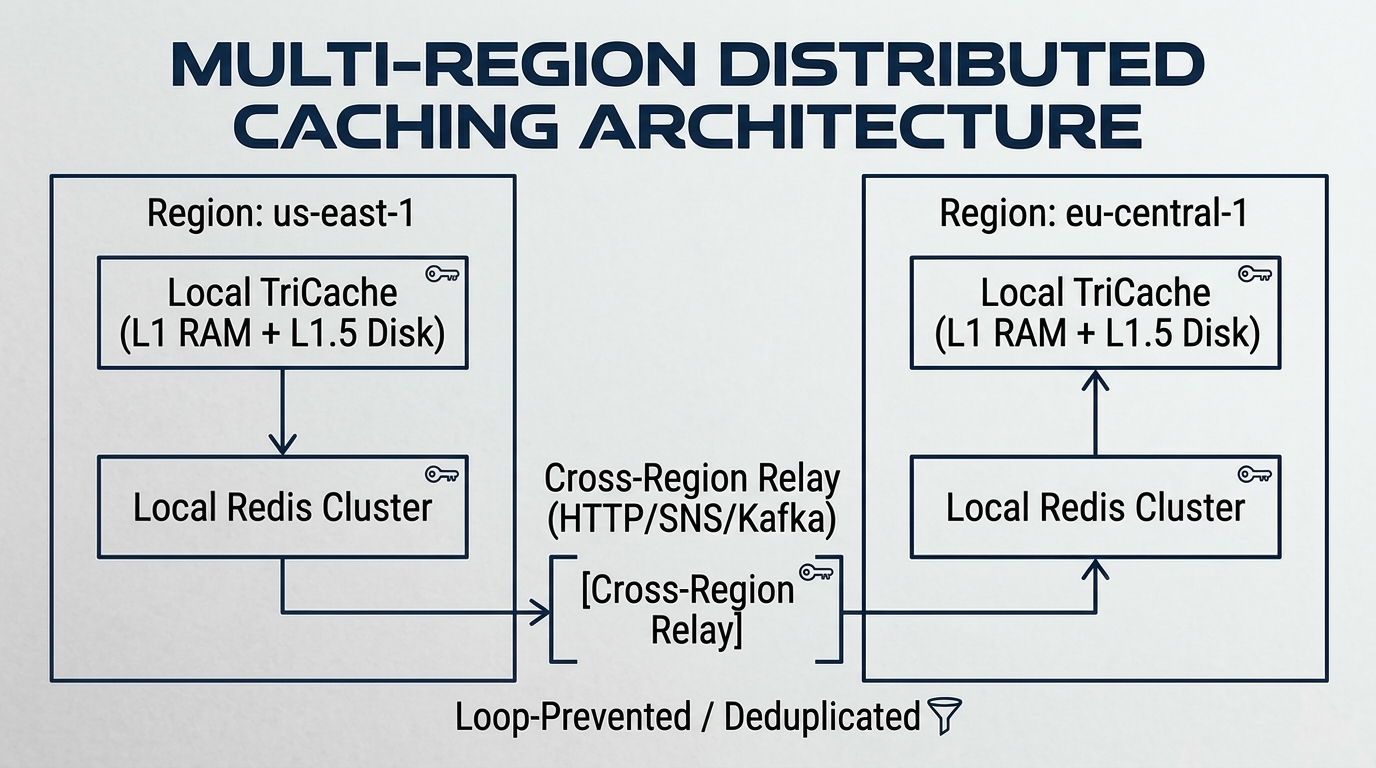
Relay Topology Diagram
┌─────────────────────────┐               ┌─────────────────────────┐
│   Region: us-east-1     │               │   Region: eu-central-1  │
│  ┌───────────────────┐  │               │  ┌───────────────────┐  │
│  │ Local TriCache    │  │               │  │ Local TriCache    │  │
│  │ L1 RAM + L1.5 Disk│  │               │  │ L1 RAM + L1.5 Disk│  │
│  └─────────┬─────────┘  │               │  └─────────▲─────────┘  │
│            │            │               │            │            │
│  ┌─────────▼─────────┐  │               │  ┌─────────┴─────────┐  │
│  │ Local Redis Cluster  │  │               │  │ Local Redis Cluster  │  │
│  └─────────┬─────────┘  │               │  └───────────────────┘  │
└────────────┼────────────┘               └─────────────────────────┘
             │                                         ▲
             │  Cross-Region Relay (HTTP/SNS/Kafka)    │
             └─────────────────────────────────────────┘
                   Loop-Prevented / Deduplicated
1. Zero-Dependency HTTP Webhook Mesh
Connect regional peer endpoints directly using Node 22 native fetch() over VPC peering or service meshes:
import { CacheService, createHttpMeshRelay, createCrossRegionWebhookHandler } from 'tricache';

const cache = CacheService.create({
  crossRegion: {
    currentRegion: process.env.AWS_REGION || 'us-east-1',
    relay: createHttpMeshRelay({
      peerUrls: ['https://eu.internal.api/cache/invalidation'],
      authSecret: process.env.CROSS_REGION_SECRET,
      timeoutMs: 3000,
    }),
    authSecret: process.env.CROSS_REGION_SECRET,
  },
});

// Framework-agnostic webhook receiver (Express / Fastify / Next.js / Node http)
const webhookHandler = createCrossRegionWebhookHandler(cache, {
  authSecret: process.env.CROSS_REGION_SECRET,
});

app.post('/cache/invalidation', async (req, res) => {
  const result = await webhookHandler({ headers: req.headers, body: req.body });
  res.status(result.status).json(result.body);
});
2. Message Broker Relay (AWS SNS/SQS, EventBridge, Kafka, NATS)
For decoupled event-driven cloud architectures:
import { CacheService, createCustomCrossRegionRelay } from 'tricache';
import { SNSClient, PublishCommand } from '@aws-sdk/client-sns';

const sns = new SNSClient({ region: 'us-east-1' });

const snsRelay = createCustomCrossRegionRelay({
  async broadcast(event) {
    await sns.send(new PublishCommand({
      TopicArn: 'arn:aws:sns:us-east-1:123456789012:global-cache-invalidation',
      Message: JSON.stringify(event),
    }));
  },
});

const cache = CacheService.create({
  crossRegion: {
    currentRegion: 'us-east-1',
    relay: snsRelay,
  },
});

// In your regional SQS / Kafka consumer:
sqsConsumer.on('message', async (msg) => {
  const event = JSON.parse(msg.Body);
  await cache.receiveCrossRegionInvalidation(event);
});
Invalidation Loop Prevention & Deduplication
- Origin Checking: If
event.originRegion === this.currentRegion, the event is dropped immediately. - UUID Ring-Buffer: Tracks the last 10,000 processed event IDs in an in-memory ring buffer, discarding duplicate transmissions without touching the local cache.
- Local Fan-Out: When an incoming cross-region event is accepted, it invalidates local L1/disk and broadcasts to the regional Redis backplane so sibling pods update instantly without re-broadcasting back to the cross-region mesh.