

Ephemeral Storage Eviction Defense
In Kubernetes clusters, pod eviction triggered by Ephemeral Storage Quotas is one of the most disruptive outage vectors for stateful and caching workloads. When a container exceeds its ephemeral storage limit or exhausts node disk capacity, the kubelet performs an immediate, non-graceful eviction:
Warning  Evicted  kubelet  The node was low on resource: ephemeral-storage.
Container app exceeded its local ephemeral storage limit "2Gi".
Unlike memory OOM kills (which terminate a single container and restart it inside the same pod), ephemeral storage eviction evicts the entire Pod immediately, descheduling it from the node and forcing Kubernetes to reschedule it elsewhere—triggering cold cache penalties, ingress traffic drops, and thundering herds.
The Root Causes in Container Caching
- Unbounded Disk Spilling: When L1 memory is under pressure, caching engines evict to local disk. If disk eviction rates lag behind write rates, disk usage spikes past container limits.
- Co-located Inodes & Temporary Files: Pods share node ephemeral storage with logs (
/var/log/pods), Docker/Containerd image layers, and/tmp. A surge in logging can trigger nodeDiskPressureeven if the cache stayed within its own budget. - Blocking Synchronous Cleanup: Standard file cleanup algorithms (
fs.rmdirSyncor large recursive sweeps) block the Node.js event loop for hundreds of milliseconds, tripping readiness and liveness probes while trying to free space.
TriCache's Multi-Tier Defense Mechanism
TriCache implements an autonomous, non-blocking storage protection engine directly inside DiskTier:
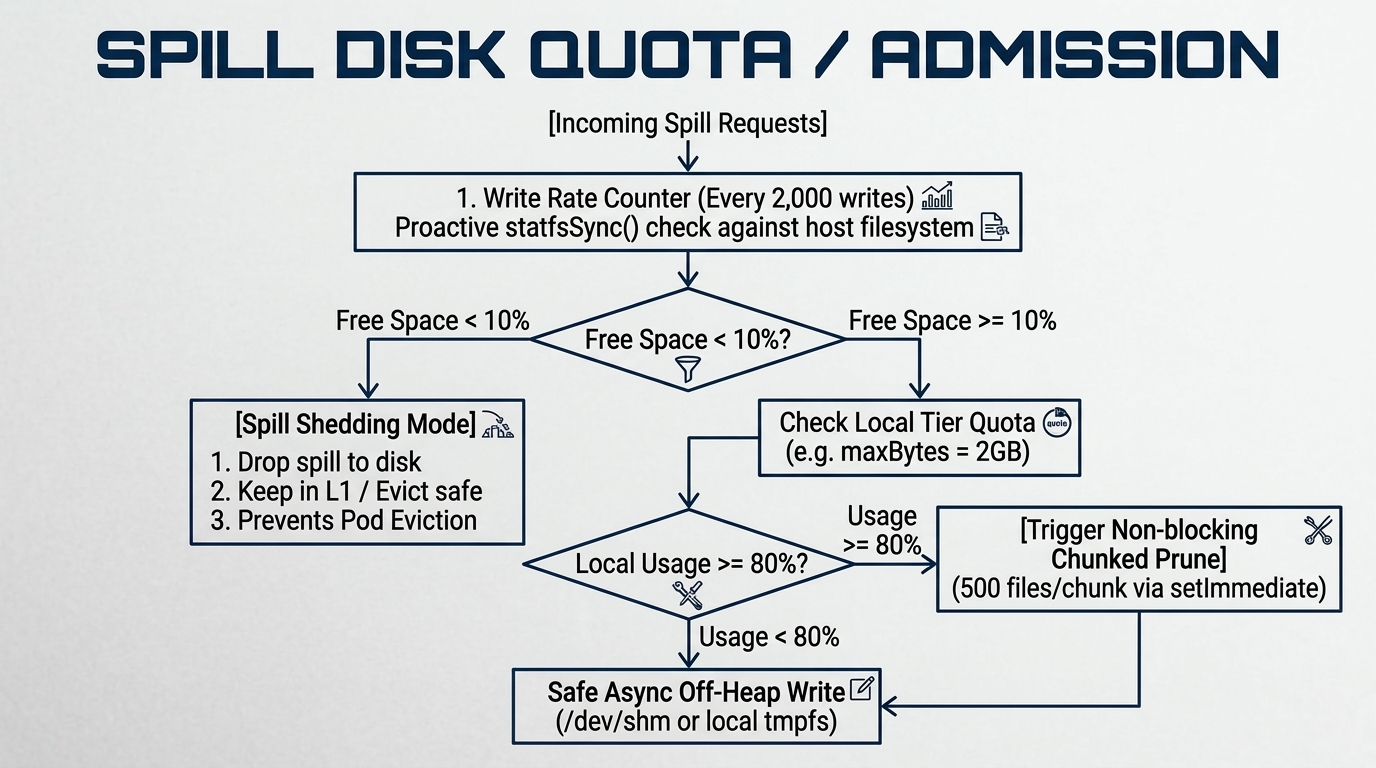
Spill Requests Workflow Details
Incoming Spill Requests
         │
         ▼
┌─────────────────────────────────────────────────────────────┐
│ 1. Write Rate Counter (Every 2,000 writes)                   │
│    Proactive statfsSync() check against host filesystem     │
└────────────────────────┬────────────────────────────────────┘
                         │
        Free Space < 10%?│ Free Space >= 10%
       ┌─────────────────┴─────────────────┐
       ▼                                   ▼
┌─────────────────────────┐  ┌────────────────────────────────┐
│ Spill Shedding Mode     │  │ Check Local Tier Quota         │
│ Drop spill to disk      │  │ (e.g. maxBytes = 2GB)          │
│ Keep in L1 / Evict safe │  └─────────────┬──────────────────┘
│ Prevents Pod Eviction   │                │
└─────────────────────────┘                ├─ Usage >= 80% ──► Trigger Non-blocking Chunked Prune
                                           │                   (500 files/chunk via setImmediate)
                                           ▼
                             ┌────────────────────────────────┐
                             │ Safe Async Off-Heap Write      │
                             │ (/dev/shm or local tmpfs)      │
                             └────────────────────────────────┘
1. Proactive Host Volume Health (statfsSync)
TriCache does not rely solely on tracking internal file sizes. It probes the actual host filesystem mounted to the container:
- Frequency: Evaluated every 2,000 write operations (or on-demand via
checkHostVolumeHealth()). - Threshold: If available disk space falls below 10% of total volume capacity, TriCache transitions the disk tier into
hostVolumeLowSpaceprotection mode. - Action: Spill writes to disk are immediately paused. Items stay in memory or are safely evicted via L1 policies, safeguarding the Pod against node-level eviction.
- Auto-Recovery: As soon as available capacity recovers above
, normal spilling resumes seamlessly with zero manual intervention.
import { CacheService } from 'tricache';

// TriCache automatically runs statfsSync on the configured disk directory
const cache = new CacheService({
  disk: {
    dir: '/dev/shm/tricache-disk',
    maxBytes: 1024 * 1024 * 1024, // 1 GB
  },
});
2. Fast Write Shedding (Zero Event-Loop Stalls)
When disk capacity reaches maximum quota (maxBytes), during active pruning cycles, or when host volume free space is
// Fast-shed incoming spills while host volume is low (<10%), pruning is active, or quota is reached
if (this._hostVolumeLowSpace || this._isPruning || this.diskUsageBytes >= this.opts.maxBytes) {
  this._spillsShedTotal++;
  return;
}- No Blocking I/O: Drops the disk write asynchronously without attempting blocking synchronous disk deletion in the request critical path.
- Zero Disruption to App: The L1 in-memory tier continues serving sub-millisecond cache hits without latency degradation.
- Observable: Increments the
_spillsShedTotaltelemetry counter, exposed via Prometheus metrics and the Visual Dashboard.
3. Non-Blocking Chunked Pruning
When disk usage crosses the 80% high-watermark, TriCache activates background chunked pruning down to the 60% low-watermark:
- 500 Entries per Chunk: Files are scanned and unlinked in batches of 500 entries at a time.
- Event-Loop Cooperative: Yields control back to the Node.js event loop using
setImmediate()between batches, guaranteeing that HTTP requests and Kubernetes health probes are never starved. - Atomic Deletion: Tracks active readers to prevent deleting files that are currently being deserialized.
4. Graceful Shutdown & Snapshot Flush (SIGTERM)
When Kubernetes scales down a deployment or rolls out an update, it sends a SIGTERM to the container before waiting terminationGracePeriodSeconds (default 30s):
// Gracefully drain and persist critical state on container teardown
process.on('SIGTERM', async () => {
  console.log('[K8s] SIGTERM received. Flushing pending disk writes...');
  await cache.close(); // Flushes memory index, awaits pending writes, closes locks
  process.exit(0);
});- Closes pending file handles cleanly.
- Removes temporary
.tmp.*atomic write staging files. - Bypasses orphan lock file retention, allowing new pods mounting shared volumes to acquire locks immediately.
Recommended Kubernetes Manifest
Ensure your container specification defines matching ephemeral storage limits and allocates off-heap /dev/shm tmpfs:
apiVersion: apps/v1
kind: Deployment
metadata:
  name: api-cache-service
spec:
  replicas: 3
  template:
    spec:
      containers:
      - name: api
        image: my-repo/api:latest
        resources:
          requests:
            cpu: "1"
            memory: "1Gi"
            ephemeral-storage: "500Mi"
          limits:
            cpu: "2"
            memory: "2Gi"
            ephemeral-storage: "2Gi" # Hard limit monitored by kubelet
        volumeMounts:
        - name: dshm
          mountPath: /dev/shm
      volumes:
      - name: dshm
        emptyDir:
          medium: Memory
          sizeLimit: 1Gi # Isolated memory bus tmpfs
TIP
Always configure TriCache's disk.maxBytes to be at least 20% lower than the Kubernetes volume sizeLimit (e.g. 800 MB cache limit for a 1 GiB emptyDir). This guarantees TriCache's 80% watermark triggers well before the container runtime can enforce a hard eviction.