

Dynamic Tier Latency Watchdog
In multi-tenant cloud clusters, host disk controllers frequently suffer from "noisy-neighbor" throttling where disk read latency degrades from 0.02ms to 50ms+. Continuing to read from a stalled disk tier degrades application throughput.
Asymmetric Redis Hysteresis
TriCache's TierLatencyWatchdog monitors real-time rolling p95 read latencies across both the disk tier and L2 Redis.
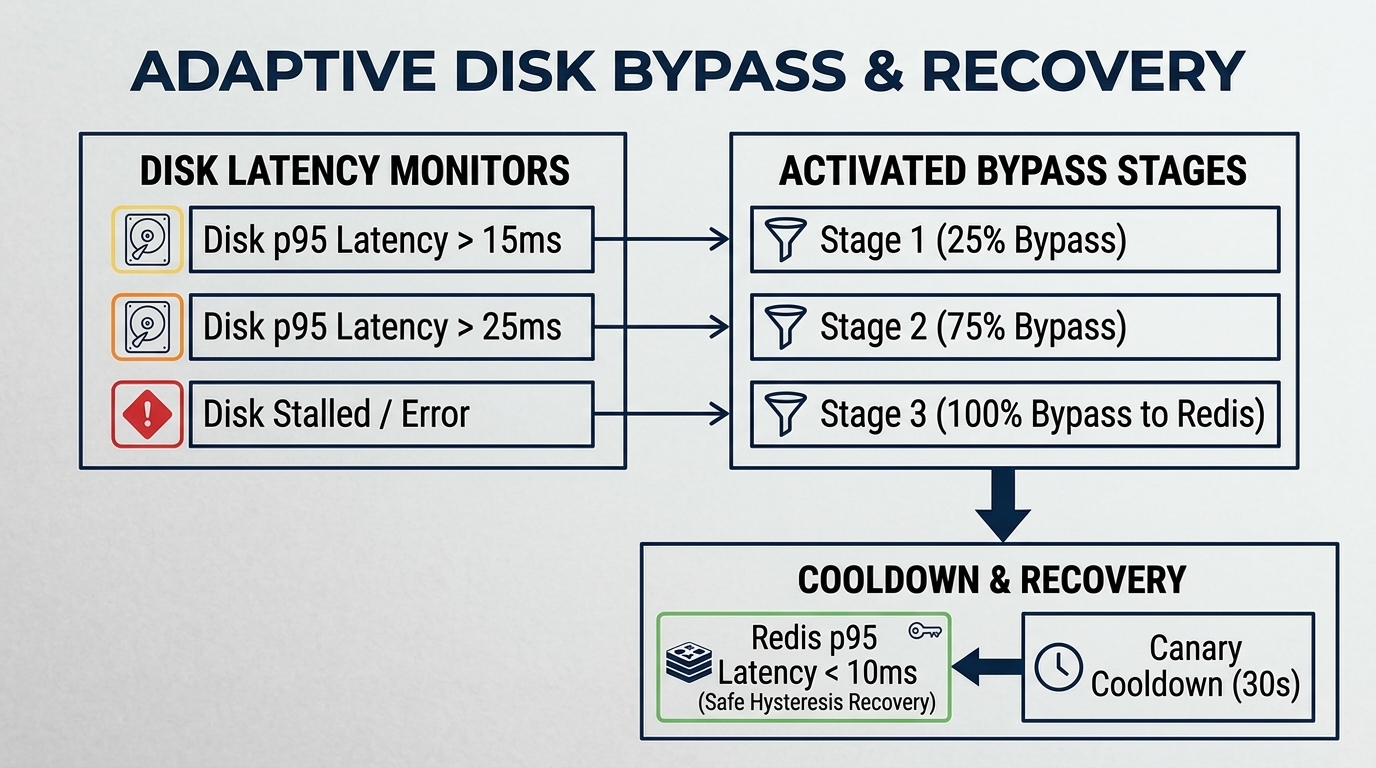
Latency Staging Architecture
Disk p95 Latency > 15ms  ───────►  Stage 1 (25% Bypass)
Disk p95 Latency > 25ms  ───────►  Stage 2 (75% Bypass)
Disk Stalled / Error     ───────►  Stage 3 (100% Bypass to Redis)
                                         │
                                         ▼
Redis p95 Latency < 10ms ◄───────  Canary Cooldown (30s)
(Safe Hysteresis Recovery)
Graduated Bypass Stages
Under cloud multi-tenancy, disk latency degrades progressively rather than failing completely. A binary on/off switch causes severe load spikes on Redis. TriCache implements a 4-stage graduated shedding state machine:
- Stage 0 (Healthy — 0% Bypass): Normal 3-tier operation. Local disk p95 latency is
or within of Redis latency. All spilled reads resolve from off-heap /dev/shmor NVMe. - Stage 1 (Light Degradation — 25% Bypass): When disk p95 crosses
and exceeds Redis latency, TriCache probabilistically diverts 25% of disk lookups directly to Redis, shaving off the longest queue tails. - Stage 2 (Moderate Degradation — 75% Bypass): When disk p95 crosses
and exceeds Redis latency, 75% of disk reads are diverted to Redis to alleviate host I/O contention. - Stage 3 (Severe Stall — 100% Bypass): When disk p95 exceeds
or encounters I/O errors, 100% of reads bypass the disk tier. Enters a randomized 30-second canary cooldown.
import { CacheService } from 'tricache';

const cache = new CacheService({
  watchdog: {
    enabled: true,
    minDiskBypassMs: 10,       // Stage 1 trigger threshold (p95 >= 10ms)
    bypassRatio: 1.5,          // Must be >= 1.5x slower than Redis
    cooldownMs: 30_000,        // Base cooldown before canary probing
    redisCutoffMs: 15,         // Redis circuit trip threshold
    redisRecoveryFloorMs: 10,  // Redis sustained recovery requirement
  },
});
Anti-Flapping Safeguard
Diverting traffic to Redis increases Redis server load. Without dampening safeguards, this creates an oscillating control-loop flapping shockwave where traffic bounces violently between disk and Redis.
1. Asymmetric Redis Hysteresis
- Diversion Cutoff: If Redis p95 response time reaches 15ms, TriCache immediately halts diversion to protect Redis from cascade exhaustion.
- Recovery Floor: TriCache strictly refuses to re-engage diversion until Redis latency drops below 10ms across 16 consecutive samples. This asymmetric gap guarantees that Redis has genuinely recovered before absorbing additional traffic.
2. Anti-Synchronicity Jitter (
When hundreds of container pods run concurrently across a Kubernetes cluster, fixed cooldown timers cause all pods to re-probe disk at the exact same millisecond. TriCache applies cryptographically uniform jitter (
3. Single-Canary Half-Open Probing
Upon cooldown expiration, TriCache permits exactly one trial read to probe the disk tier. All concurrent application requests remain shielded and diverted until the canary read completes successfully under the latency threshold.
Real-Time Telemetry & Introspection
Monitor the latency watchdog state machine, rolling p95 latencies, and total bypassed requests:
const stats = cache.getWatchdogStats();

console.log(stats);
// {
//   bypassActive: false,
//   bypassStage: 0,
//   diskP95Ms: 0.04,
//   redisP95Ms: 1.25,
//   redisDampened: false,
//   bypassedTotal: 0
// }