

/dev/shm (POSIX Shared Memory / tmpfs)
In cloud Kubernetes clusters (AWS EKS, GCP GKE, Azure AKS), containers do not run on dedicated bare-metal NVMe drives by default. They are constrained by:
- Network-Attached Persistent Volumes (AWS EBS / GCP PD): Remote disk latency fluctuates between 1ms and 350ms during multi-tenant throttling, burning burst IOPS credits.
- Docker / Containerd Overlay Filesystem: Copy-on-write overlay filesystems trigger inode contention and high write amplification.
- Strict Ephemeral-Storage Quotas: If a container cache fills
/tmp, the Kuberneteskubeletterminates the pod immediately (Pod was evicted). - Zero-Trust Security Policies: Hardened enterprise clusters enforce
readOnlyRootFilesystem: true, blocking writes to standard filesystem directories.
The Solution: Target /dev/shm
TriCache automatically detects Linux container runtimes and targets /dev/shm when writable and provided with adequate capacity (
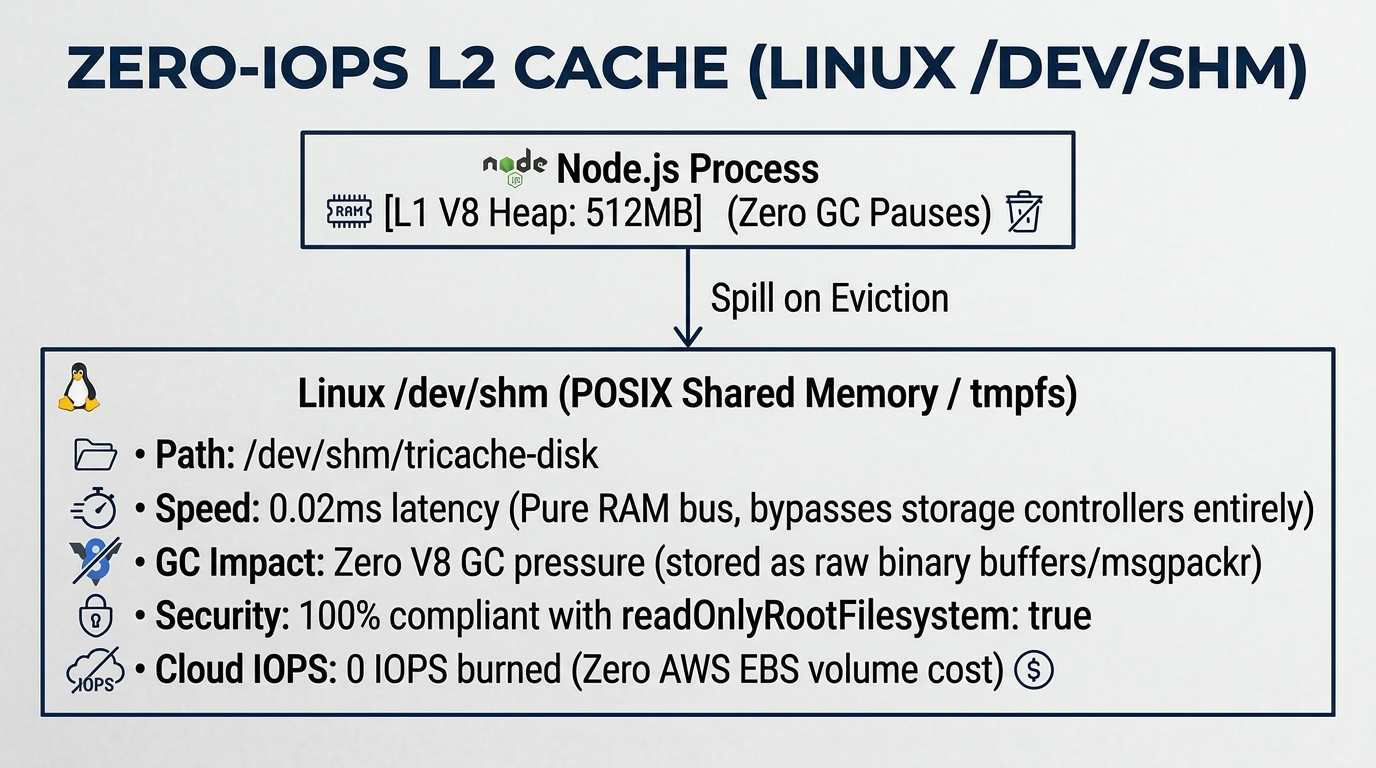
Memory Bus & Spill Topology
                      ┌─────────────────────────────────────────┐
                      │            Node.js Process              │
                      │  [L1 packed-data budget: 512MB]          │
                      └────────────────────┬────────────────────┘
                                           │ Spill on Eviction
                                           ▼
┌────────────────────────────────────────────────────────────────────────────────────────┐
│   Linux /dev/shm (POSIX Shared Memory / tmpfs)                                         │
│   • Path: /dev/shm/tricache-disk                                                       │
│   • Speed: 0.02ms latency (Pure RAM bus, bypasses storage controllers entirely)        │
│   • GC Impact: encoding, buffers, and decoded values still use Node memory             │
│   • Security: writable mount required with readOnlyRootFilesystem: true                │
│   • Cloud IOPS: 0 IOPS burned (Zero AWS EBS volume cost)                              │
└────────────────────────────────────────────────────────────────────────────────────────┘
Why SREs Approve This Pattern
- Memory Accounting: Persisted tmpfs files are outside V8's managed heap but still count against cgroup memory. Encoding, I/O buffers, and decoded objects still allocate; there is no zero-GC or OOM guarantee.
- Local Storage Latency: Benchmark actual read/write latency on the target runtime and filesystem rather than assuming a fixed 20µs bound.
- Zero Cloud IOPS: Does not touch cloud storage volumes, eliminating EBS burst credit exhaustion.
- Read-Only Root Compatibility: Requires a separate writable mount. This setting alone does not establish CIS/SOC2 compliance.